
Reviewed · DOWNTOWN LOS ANGELES TOURS
The History and Architecture of Downtown Los Angeles
Downtown Los Angeles reveals its best secrets at street level, where Victorian Bunker Hill, grand movie palaces, Japanese American history, modern art, and old bank buildings meet within a few city blocks. This three-hour walk with Chris of See LA in a Day gives you that broad view, beginning with a ride on Angels Flight and ending near Grand Central Market.
I like the mix of architecture and everyday life, especially the stop at Fugetsu-Do for traditional mochi and the time spent in Little Tokyo. I also like that the tour loops back to its starting point, a useful detail if you have a car, a dinner reservation, or more sightseeing planned. The main consideration is pace: several landmarks receive only five to fifteen minutes, and the route gives less attention to Los Angeles’s Spanish and Mexican beginnings than some visitors may expect.
Key points at a glance
- A ride on Angels Flight is included, linking present-day Bunker Hill with the Victorian neighborhood that once occupied the hill.
- Chris leads the walk, bringing strong knowledge of Downtown LA architecture, local history, and small businesses.
- Little Tokyo gets real attention, including historic markers, legacy businesses, restaurant ideas, and a mochi sample from Fugetsu-Do.
- You see major modern landmarks, including MOCA, The Broad, Walt Disney Concert Hall, and City Hall.
- The Historic Core gets its due, with the Bradbury Building, Million Dollar Theater, old bank district, and The Last Bookstore.
- The group is limited to 15 people, and the approximately three-hour tour begins and ends at 341 South Hill Street.
Why this Downtown LA walk is different
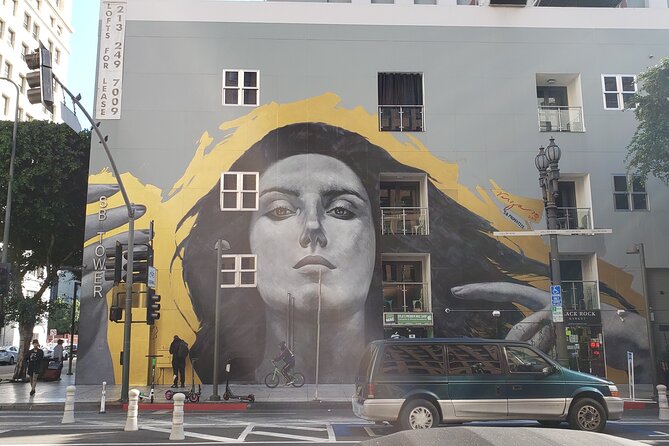
Many Los Angeles tours chase celebrity addresses or film locations. This one takes another route. It treats Downtown LA as a city of layers: a small settlement that became a financial center, a once-fashionable residential district that was reshaped by redevelopment, and a collection of old neighborhoods now sharing space with art museums, restaurants, offices, and civic buildings.
That approach works well because Downtown can seem scattered when you explore it alone. One block offers a 19th-century cathedral, another gives you a spectacular movie palace, and then a modern concert hall appears around the corner. Chris helps connect those pieces rather than presenting each building as an isolated photo stop.
The tone also appears to be personal rather than scripted. Chris has led tours in Downtown LA for about a decade, and his background shows in the way he connects buildings with local businesses and neighborhood life. He also uses pictures during the walk when an older building or lost neighborhood needs more explanation.
The small-group limit matters here. With no more than 15 people, you should be able to hear the guide and ask questions without the feel of a large bus tour. Several people who took the walk describe Chris as friendly, funny, patient, and attentive to shade and comfort. Those details matter in Los Angeles, where sun, heat, and busy sidewalks can shape your experience as much as the sights do.
More Downtown LA tours in Los Angeles:
- Downtown Los Angeles Food Tour
★ 5.0 · 501 reviews - Old and New Downtown Los Angeles Walking Tour
★ 5.0 · 222 reviews - Culture and Arts Tour of Downtown LA with Angels Flight Ticket
★ 5.0 · 142 reviews
Angels Flight and the vanished homes of Bunker Hill
The tour opens at 341 South Hill Street, beside Angels Flight Railway. The ride is included, so you are not paying an extra fare for one of Downtown’s most recognizable small attractions.
Angels Flight is billed here as the shortest train ride in the world. The ride itself is brief, but the story behind it gives the opening real weight. Chris explains how Bunker Hill once held Victorian homes and a residential community, then changed as Los Angeles developed its modern financial district.
This is an important early lesson: Downtown LA did not simply grow in a straight line. Older neighborhoods were cleared, buildings disappeared, and the hill was remade. From the railway, you begin to see how the old and new parts of Downtown sit beside each other.
You will also get views of well-known skyscrapers, including buildings recognized from films such as Independence Day. The stop is short, so do not expect a full architecture lecture on every tower. Instead, it sets up the larger story of how the city changed.
MOCA, The Broad, and the modern face of Bunker Hill
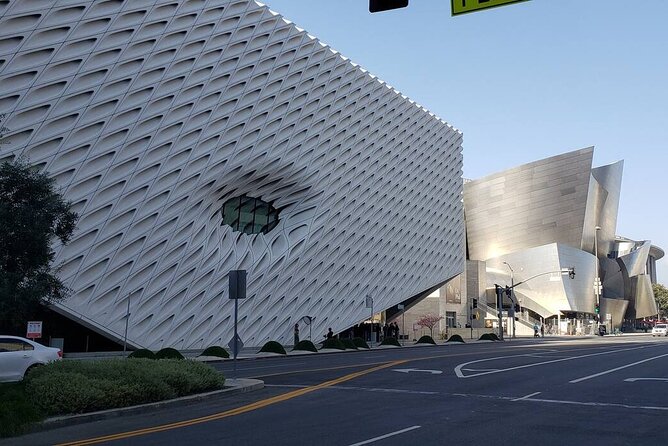
The next stretch moves through Bunker Hill and past two major free art museums: the Museum of Contemporary Art and The Broad. The tour does not include a museum visit, and each exterior stop is only about five minutes, so plan to return later if you want to see the collections.
At MOCA, Chris discusses the architect behind the building and the early struggles of that architect’s career. The point is not just to admire the structure. You get a little context about how major cultural buildings come into being, including the people and problems behind the finished design.
The Broad offers a different lesson. Its honeycomb-like exterior is hard to miss, and Chris explains how to pronounce the museum’s name correctly. He also discusses its Pop Art collection and plans for future additions. That makes the stop useful even if you have already photographed the building, since you hear how the museum fits into Downtown’s expanding art center.
I would treat both museums as orientation stops, not substitutes for admission. The value comes from seeing how Bunker Hill combines public art, architecture, and major cultural institutions within a compact area.
Walt Disney Concert Hall and Grand Park
Walt Disney Concert Hall receives about 15 minutes, giving it more time than most stops. Frank Gehry’s sweeping stainless-steel exterior is one of the defining sights of modern Los Angeles, and Chris explains both the design and the long story behind the building’s creation.
This is one of the strongest architecture stops because the building is easy to admire but harder to understand. The tour gives you a chance to look past the dramatic curves and hear about the planning, ambition, and complications that shaped the concert hall.
From there, the route moves toward City Hall through Grand Park. The focus shifts from private culture to public power. City Hall becomes a way to discuss how Los Angeles grew from a town of only 44 people into a city of millions.
That scale of change can be difficult to grasp from a guidebook paragraph. Seeing civic buildings, public spaces, and the surrounding towers together makes the growth story easier to picture. The City Hall stop is about 10 minutes, so you receive a concise explanation rather than a long interior tour.
More history tours in Los Angeles:
- Natural History Museum of Los Angeles County Admission
★ 4.5 · 111 reviews - Downtown Los Angeles History and Architecture Walking Tour
★ 5.0 · 93 reviews - Malibu: Celebrity Homes, Beaches & History Tour
★ 4.7 · 86 reviews - The History and Architecture of Downtown Los Angeles
★ 5.0 · 66 reviews
Little Tokyo, with time for local flavor
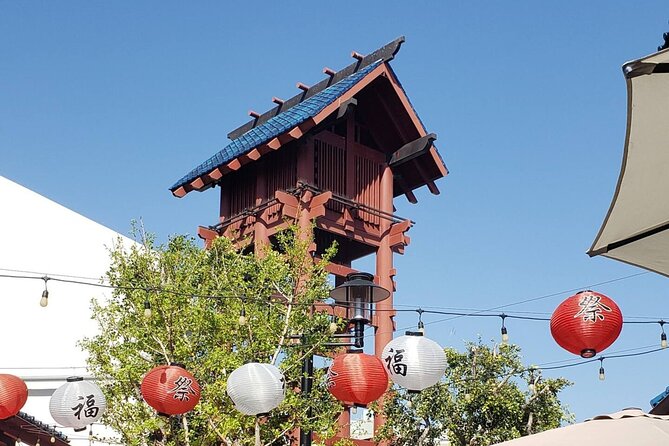
Little Tokyo is one of the most valuable parts of the route because it adds social history to the architecture. Chris points out historic markers, long-running businesses, restaurants, and places that show how Japanese communities shaped California and Los Angeles.
You spend about 30 minutes here, more than at any other neighborhood stop. That extra time matters. Little Tokyo is not treated as a quick pass through on the way to the next building. You have room to notice how the district works as a living community, not just as a historic label.
The tour also includes a traditional Japanese snack from Fugetsu-Do, a family business that opened in 1903. The Kito family kept it going through two world wars, the Great Depression, and more than 120 years of change. Sampling its mochi gives the history a direct, memorable connection to the present.
This is one of the tour’s smartest choices. A lecture about immigrant communities can remain abstract. A stop at a long-running family business gives you a physical sense of continuity, work, and adaptation.
Fugetsu-Do and the meaning of a legacy business
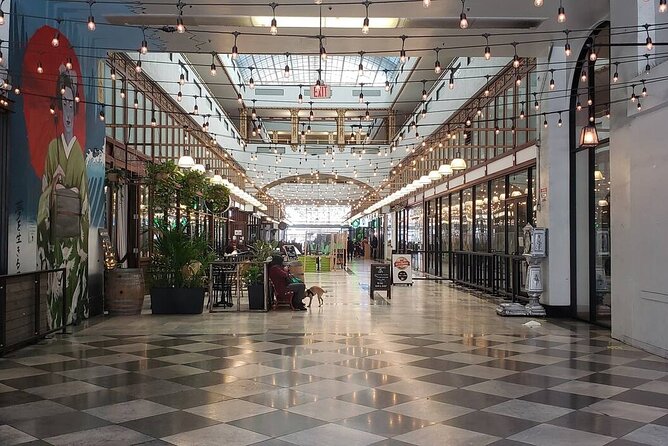
Fugetsu-Do is more than a snack stop. Its story adds a human scale to the larger history of Downtown. The business survived periods that closed or transformed countless small shops, yet it remains part of Little Tokyo’s daily life.
You should not expect a full food tour. The mochi sample is one small part of a much wider walking experience. Still, it gives the afternoon a welcome pause and introduces you to a local institution you could revisit on your own.
Chris also offers food recommendations during the tour. That can be useful if you want to stay downtown for lunch or dinner, though the activity does not promise a complete meal or a long series of tastings.
Vibiana and Broadway’s old movie palaces
After Little Tokyo, the walk returns to older Downtown landmarks. Vibiana, originally St. Vibiana’s Cathedral, dates to 1876 and is described as the oldest building along the route. At the time it was built, nearly one-fifth of Los Angeles’s entire population could fit inside.
That fact gives you a sharp sense of the city’s former size. Today’s Downtown towers can make Los Angeles seem vast and established, but Vibiana points back to the period when the city was still small enough for one cathedral to hold a substantial share of its residents.
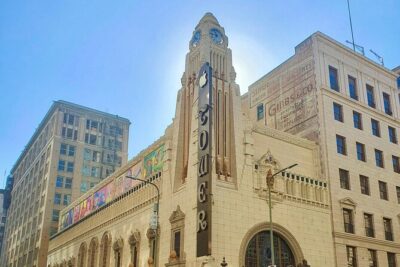
The route then reaches the Million Dollar Theater on Broadway. Broadway once held the largest concentration of historic movie palaces in the United States, and this theater remains one of the grandest examples. The tour connects the building to Hollywood history, including premieres associated with stars such as Charlie Chaplin.
The stop lasts only about five minutes. You will learn why the theater matters, but you will not receive an extended interior visit. If historic theaters are your main interest, you may want to make a separate plan to explore Broadway more fully.
The Bradbury Building and Spring Street’s financial past
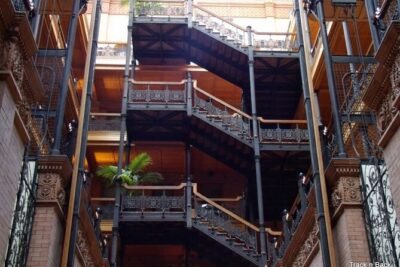
The Bradbury Building receives about 10 minutes, which is enough to appreciate its unusual design and hear the story behind the 1893 building. It is one of the tour’s most visually memorable stops, with details that reward a slower look.
From there, the walk follows Spring Street through the old bank district. This section works like an outdoor timeline of architecture. You see changes in materials and styles, moving from iron and steel to Beaux Arts and Art Deco.
The larger story is financial ambition. Downtown was once known as the Wall Street of the West, and the bank buildings reflect the money and confidence that helped shape early 20th-century Los Angeles.
This part of the tour is especially useful if you tend to look only at famous landmarks. Spring Street teaches you to read the ordinary-looking blocks between them. A doorway, facade, or upper-story detail can reveal the age and purpose of a building even when no major attraction is announced.
The Last Bookstore and Grand Central Market
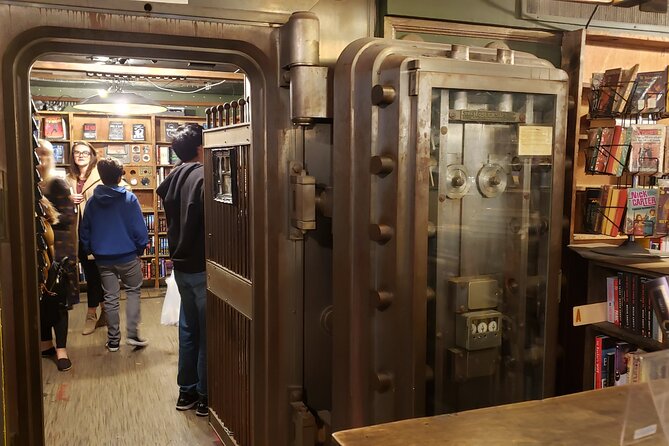
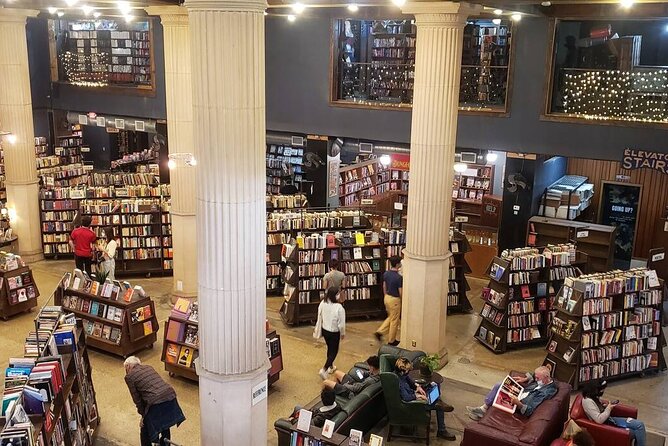
The Last Bookstore is the final major stop before the tour returns to its meeting point. It occupies an original bank building, and Chris explains the structure’s past, including the old vault. The shop is also known for photo-friendly spaces, so you get a pleasant change of pace after so much civic and architectural history.
This stop is brief, around 10 minutes. You will have time to look around, but not necessarily enough for an extended browse through the store. If you enjoy books, plan to return later with more time.
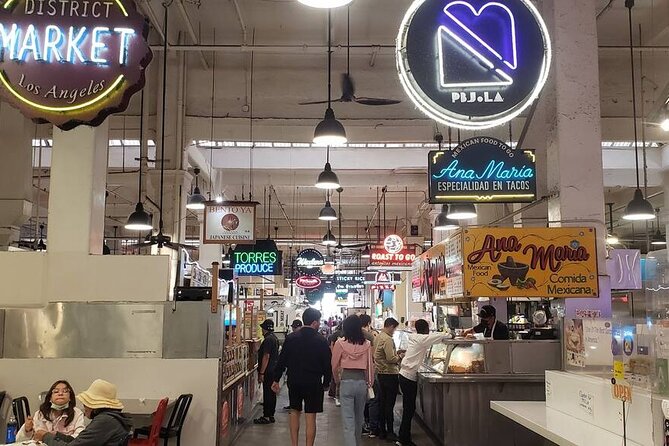
The tour ends at Grand Central Market, a Downtown food hall that has operated for more than 100 years. It is a fitting finish because the market brings together the old and new sides of Los Angeles: historic surroundings, local food, and a place that still functions as part of everyday city life.
The activity ends back at the original meeting point rather than leaving you across town. That closed loop is practical for parking, public transportation, and planning the rest of your day.
Price, pace, and practical value
At $39.20 per person, this is a fair price for a three-hour small-group walk that includes the Angels Flight ride and a mochi sample. You are paying mainly for interpretation and organization, not expensive admissions. The museums and most landmarks are viewed from outside, and the route does not include a full meal.
I think the price works best for first-time Downtown visitors, curious locals, and anyone who wants a clear framework before exploring alone. A guide can show you what to notice in a building and explain why a district changed. That saves time and adds meaning to sights you might otherwise pass without a second look.
The route requires walking and good weather. A hat is sensible, even in cooler months, and comfortable shoes will make the three hours easier. The guide has been attentive about stopping in shade, but conditions can still be sunny or warm.
The activity is offered in English, with mobile tickets. Service animals are allowed, and the tour is near public transportation. Most people can participate, though anyone concerned about walking should ask the provider for current details before booking.
You can cancel for a full refund up to 24 hours before the start time. Cancellations or changes within 24 hours are not refunded, and poor weather or failure to meet the minimum group size can lead to a rescheduled tour or full refund.
What the tour does not cover
The route gives strong attention to Japanese American history, Downtown architecture, civic buildings, and the old financial district. It gives less attention to the Spanish and Mexican founders of Los Angeles.
There is no stop at Olvera Street. That omission is understandable within a three-hour loop, since adding it would require a much longer route and would interfere with the return to Little Tokyo and the Historic Core. Still, if early Los Angeles, Plaza Olvera, or Mexican and Spanish colonial history is your main interest, you should pair this tour with a separate visit.
The short stop times are another limitation. You see many places, but you do not explore each one at length. I see that as a deliberate tradeoff: broad coverage instead of a slow architectural seminar.
Should you book this Downtown LA tour?
Book it if you want to understand how Downtown Los Angeles developed, not just collect photos of famous buildings. Chris’s style suits people who like questions, detailed stories, architecture, social history, and practical food suggestions.
It is also a strong choice for locals who think they already know the city. The route includes enough overlooked detail to change how you read familiar streets. The included Angels Flight ride and Fugetsu-Do mochi give it two memorable touches beyond a standard building walk.
Skip it if you want extensive museum time, a full food crawl, or a tour focused on Hollywood and celebrity culture. Also look elsewhere if your top priority is the Spanish and Mexican founding story of Los Angeles.
For most curious visitors, though, $39.20 buys a useful introduction to a complicated part of the city. You finish with a better sense of why Downtown looks the way it does, plus several places worth revisiting at your own pace.
FAQ
How long does the Downtown Los Angeles tour last?
The tour lasts approximately three hours.
Where does the tour begin?
It begins at 341 South Hill Street, Los Angeles, California 90013.
Where does the tour end?
The tour ends back at the original meeting point.
Is the Angels Flight ride included?
Yes. The tour includes admission for a ride on Angels Flight Railway.
Does the tour include food?
Yes. The route includes a traditional Japanese mochi sample at Fugetsu-Do in Little Tokyo.
Does the tour enter the museums?
The tour visits the Museum of Contemporary Art and The Broad from the outside. Admission to those museums is not part of the experience.
How large is the group?
The tour has a maximum of 15 people.
What language is the tour offered in?
The tour is offered in English.
What happens if the weather is poor?
The experience requires good weather. If it is canceled because of poor weather, you can choose a different date or receive a full refund.
Just added around Los Angeles
- Photo Tour of Los Angeles for Social Media★ 5.0 · 11 reviews
- Pacific Coast Highway: Smartphone Audio Tour, LA to Santa Maria★ 4.0 · 13 reviews
- Pasadena Puzzle Adventure: Stop the Bomb!★ 3.5 · 5 reviews
- Outdoor Escape Room in LA – Little Tokyo★ 5.0 · 7 reviews
- 3.5-Hour LA Story Tour: Our Most Popular Los Angeles Tour!★ 5.0 · 4 reviews
- 2 Day Beginner Surf Adventure★ 5.0 · 26 reviews
- Getty Center Tours for KIDS and FAMILIES!★ 5.0 · 5 reviews
- Private 3-Hour Hollywood to Beverly Hills Tour★ 5.0 · 5 reviews
Downtown Los Angeles Tours, compared.

Downtown Los Angeles History and Architecture Walking Tour
Read our review →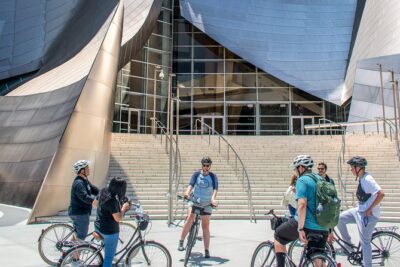
The History and Architecture of Downtown Los Angeles
Read our review →
Browse the lists this tour appears in