
Reviewed · DOWNTOWN LOS ANGELES TOURS
Downtown Los Angeles History and Architecture Walking Tour
Downtown Los Angeles is easiest to understand on foot, where a food hall, movie palace, bank tower, and old railway can tell one connected story. This tour with Eloi Mark looks at DTLA through architecture, film, urban design, and the city’s constant reinvention. It is less a march from landmark to landmark than a guided conversation about why the district became what it is.
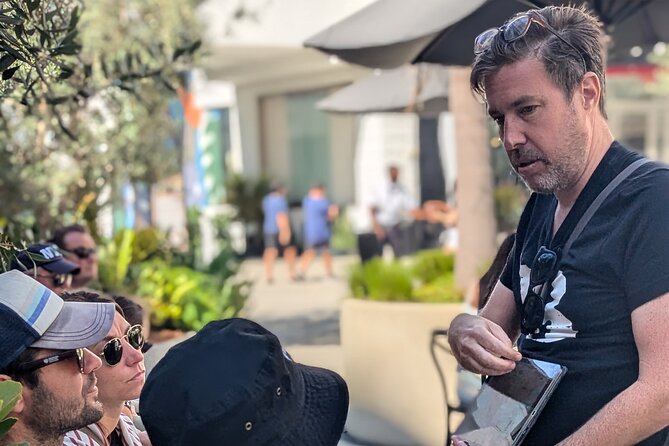
I like the use of old photographs and maps, which help you compare today’s streets with the city that came before. I also like the small group, capped at 15 people, since you can ask questions and follow an interesting thread. The main caution is that this is a long, steady walk with few built-in rest stops, and some people have found it hard to hear the guide on noisy streets.
What makes this DTLA walk worth your time
- Movie palaces with real screen history: See Broadway’s grand theaters and the former Tower Theatre, now an Apple store.
- Architecture with a wider story: Beaux-Arts banks, Art Deco facades, a 1904 skyscraper, and a famous film location all fit into one walk.
- Old and new Los Angeles together: Grand Central Market, The Last Bookstore, Clifton’s, and Hotel Per La show how older buildings keep finding new uses.
- A guide who connects places: Eloi Mark brings a European and international viewpoint to local history and urban design.
- A small group capped at 15: The format gives you a better chance to ask questions and talk through ideas.
- A useful route for curious locals: Even people who have lived in California for decades may see familiar streets differently.
A thoughtful start at Grand Central Market
The tour begins at the Grand Central Market parking garage on South Hill Street, just beside one of DTLA’s most useful starting points. Grand Central Market opened in 1917, and its food stalls reflect the city’s many communities, from Mexican tacos and Salvadoran pupusas to Japanese ramen and Jewish pastrami.
You get about 10 minutes here, so this is an introduction rather than a meal break. If you arrive early, you can come hungry and eat before the walk, but do not count on the tour itself giving you time to browse every stand.
The guide’s personal story shapes the tone. Eloi grew up in Belgium, spent a decade in China, and has lived in DTLA for four years. He also hosts a podcast about the district. That background gives him a useful habit of comparison. A local railway may remind him of Lisbon or Hong Kong, while a financial building can be connected to Antwerp or London. These comparisons help you see Los Angeles as part of a wider urban story, not as an isolated movie town.
More Downtown LA tours in Los Angeles:
- Downtown Los Angeles Food Tour
★ 5.0 · 501 reviews - Old and New Downtown Los Angeles Walking Tour
★ 5.0 · 222 reviews - Culture and Arts Tour of Downtown LA with Angels Flight Ticket
★ 5.0 · 142 reviews
Angels Flight and the climb toward Bunker Hill
Angels Flight is a tiny funicular with a large place in the city’s memory. Built in 1901, it once carried people between the lower part of downtown and Bunker Hill. The ride is short, but the idea behind it is important: early Los Angeles needed practical ways to move people up and down its steep streets.
The experience compares naturally with Lisbon’s hillside lifts or Hong Kong’s Peak Tram, though Angels Flight has its own compact character. The itinerary includes this stop as part of the walk, but the supplied information does not promise that a ticket ride is included. Ask the guide on the day if riding it matters to you.
From here, the story turns toward Bunker Hill and the steep steps that link the district’s past to its present. Bunker Hill was once a wealthy residential area. It later became a center for culture, offices, and finance. The steps are a good place to consider how much of Los Angeles has been rebuilt, renamed, or given a new purpose.
Pershing Square and the problem of public space
Pershing Square is not presented simply as a pretty park or a photo stop. It becomes a way to talk about what public space should do in a modern city. Once a major civic gathering point, the square has changed as DTLA changed around it.
The comparison with Madrid’s Puerta del Sol or Beijing’s Tiananmen Square makes the question larger than Los Angeles. Who is a city built for? How open should a public square be? What happens when public areas are shaped by private interests or commercial pressure?
This part will suit you if you enjoy urban planning and civic questions. If you want only dates and building names, the discussion may feel less direct. The tour’s approach is story-led and analytical, not a technical architecture class.
Broadway’s movie palaces and the Million Dollar Theater
The Historic Theater District on Broadway is one of the strongest parts of the route. This short section contains the largest concentration of movie palaces in the world, with grand facades packed close together. You get about 20 minutes here, enough to understand the district’s role even if access to every theater is not available.
The Million Dollar Theater was the first movie palace built by Sid Grauman. Its design helped shape the grand cinema style that later spread around the world. The useful point here is not only that the building is ornate. It shows how early cinema was sold as a complete evening out, combining architecture, spectacle, and the promise of modern life.
The theaters also help explain Hollywood’s rise. Before streaming and home screens, the building itself was part of the attraction. A night at the movies meant entering a dramatic interior, often with chandeliers, carved decoration, and a sense of occasion.
More walking tours in Los Angeles:
- Los Angeles Original 90-Minute Walking Tour to The Hollywood Sign
★ 5.0 · 693 reviews - LA: Express Hollywood Sign Guided Walking Tour with Photos
★ 4.9 · 310 reviews - Haunted Hollywood Walking Tour: True Crime and Creepy Tales
★ 5.0 · 299 reviews - Los Angeles: Hollywood Sunset Walking & Hiking Tour
★ 5.0 · 230 reviews
The Bradbury Building and film inside architecture
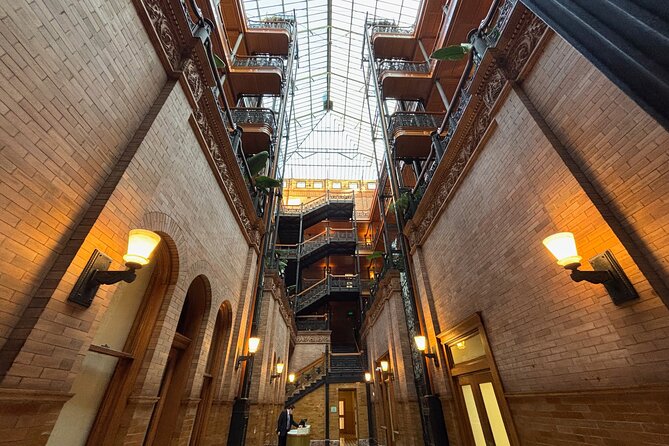
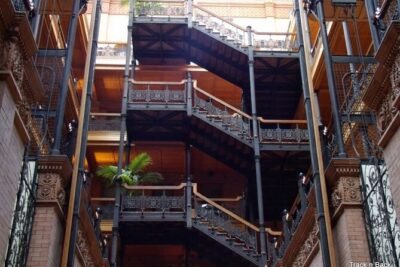
The Bradbury Building is one of the tour’s most memorable interiors. Its open atrium, iron stairways, wood detail, and changing light create a space that feels unlike the streets outside. The building has also appeared in films, most famously Blade Runner, which makes it especially appealing if you enjoy the link between real places and screen fantasy.
You will have about 10 minutes here. That is enough to look up, notice the staircases, and hear why the building has become such a powerful image of Los Angeles. It is a good example of the tour’s method: architecture is not treated as decoration alone. The building becomes part of the city’s film identity.
Access inside historic buildings can change, so you should expect to see the Bradbury from the areas open to the public on that day rather than assume every part is available.
Banks, skyscrapers, and the Old Bank District
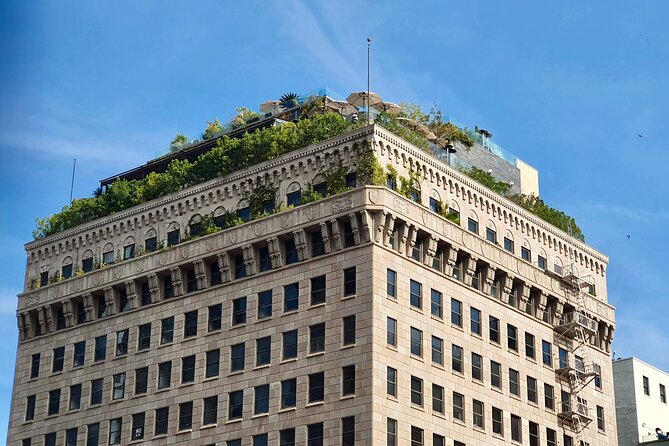
The Old Bank District brings you into the financial story of downtown. Spring Street was once known as the Wall Street of the West, and its Beaux-Arts buildings express the confidence of a growing Pacific Coast city.
The Continental Building, completed in 1904, was among Los Angeles’s first high-rises. Its importance is easy to miss if you only look at the skyline from a distance. On foot, you can study the facade and understand how early builders used European-inspired design to give a young city a sense of permanence.
The El Dorado Lofts adds another layer. Built in 1913 as a luxury hotel, it has a terra cotta exterior with floral and geometric decoration tied to the Art Nouveau and Art Deco styles. Its later conversion into residential lofts shows how DTLA buildings survive by changing use.
You also pass the Arcade Building, completed in 1924. It once held studios and offices connected to Los Angeles’s early radio industry. Today, its spaces serve newer businesses. That contrast captures the district well: old structures remain useful, but their purpose keeps shifting.
Books, restaurants, and the pleasure of adaptive reuse
The Last Bookstore is a lively pause in a route filled with banks and theaters. Its book tunnel, tall shelves, records, rare books, and local art make it part shop and part art installation. You get about 10 minutes, so plan to return on your own if you want time to browse.
This stop works because it brings the city’s cultural life into the walk. DTLA is not only about grand buildings from a previous age. It also has places that attract readers, artists, and small creative businesses today.
Clifton’s offers a different kind of reinvention. Founded in 1931, the cafeteria became known for providing free meals to people in need during the Great Depression. Its present design includes a large tree, forest-style rooms, and hidden tiki bars. The place turns dining into theater, but the older story of service gives the spectacle some weight.
You may not get a full meal or a long indoor visit during the tour. Think of these stops as introductions to places worth returning to later.
The Los Angeles Theatre and Hollywood’s golden dreams
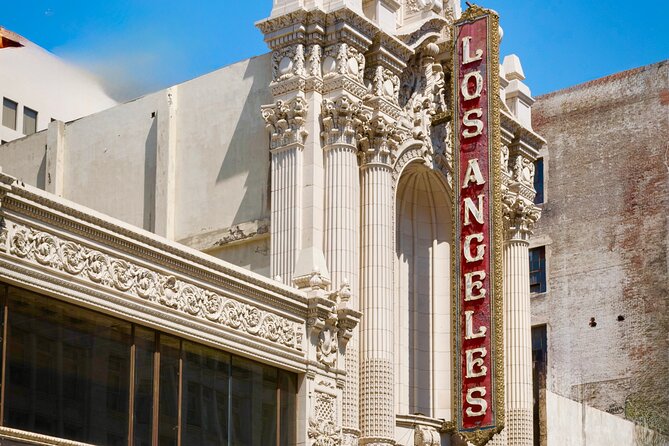
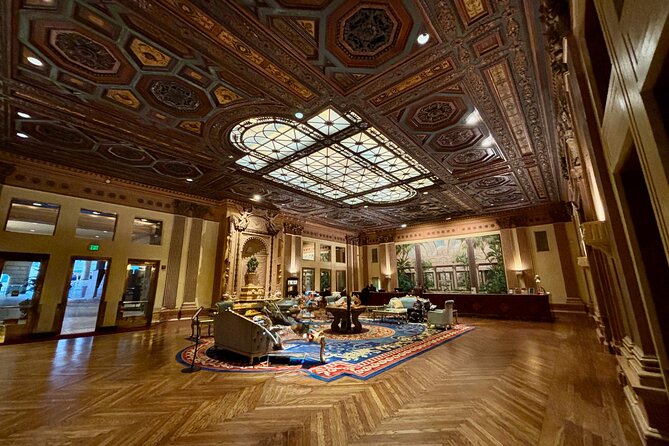
The Los Angeles Theatre dates from 1931 and opened for the premiere of Charlie Chaplin’s City Lights. Its crystal chandeliers, gold details, marble stairs, and grand interior were designed to make moviegoing feel like a visit to an opera house.
This is where the tour’s architecture and film themes meet most clearly. The building shows how much effort once went into making a cinema feel special. It also fits the worldwide story of movie palaces, many of which later closed, changed purpose, or struggled to remain useful.
The tour includes the theater as a 10-minute stop, but the information does not guarantee a full interior tour. Access may depend on the building’s schedule. Even from the street or an available public area, the theater adds useful context to Broadway’s collection of cinemas.
The Tower Theatre, from talkies to Apple
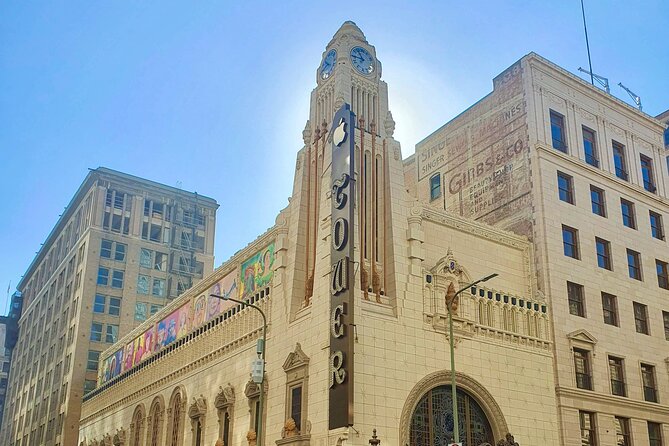
The former Tower Theatre is one of the clearest examples of adaptive reuse on the route. Built in 1927, it was the first Los Angeles theater designed for films with synchronized sound. Its opening of The Jazz Singer marked a major change in the way audiences experienced movies.
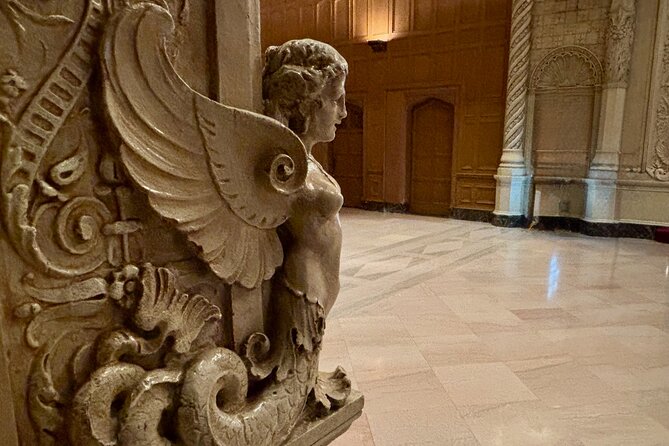
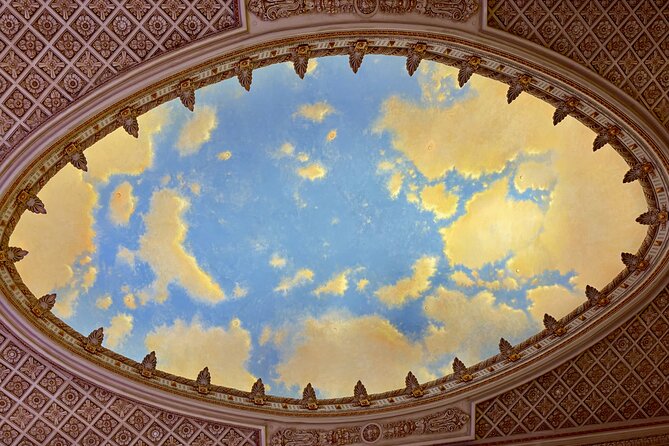
The Spanish Renaissance Revival design includes carved details, stained glass, and vaulted ceilings. The building also appeared in the Silencio scene from David Lynch’s Mulholland Drive, a film connection that suits the theater’s dreamlike mood.
Today, Apple uses the building as a flagship store. The technology is new, but the historic shell remains part of the experience. You do not need to be an Apple fan to appreciate the point. A building can survive when a new use respects enough of its old character to keep the place recognizable.
Jewelry, fashion, and the working side of DTLA
The Jewelry District covers 12 blocks and is described as the largest jewelry district in the United States. Its roots reach back to the 1920s. The comparison with Antwerp, where Eloi grew up, gives this stop a personal connection as well as an economic one.
You will hear about craftsmanship, trade, and the people who built businesses around precious goods. The district is not just a row of shiny displays. It shows how immigrant communities, entrepreneurs, and specialized workers helped shape downtown commerce.
The Fashion District adds another working layer. This is where textiles, clothing, and streetwear businesses help shape trends. It may not have the polished image of a famous Paris shopping avenue, but that is part of its value. You see the production and trade behind style, not just the finished display.
Nearby, the Eastern Columbia Lofts provide a strong visual contrast. Its turquoise terra cotta and clock tower make it one of the city’s most recognizable Art Deco buildings. Built in 1930, it reflects the optimism and ornament of the period. The building is also linked with celebrity residents, including Johnny Depp, adding a small Hollywood note to the architecture.
Hotel Per La and the final view of downtown
The walk ends at Hotel Per La, formerly the Bank of Italy building, at 649 South Olive Street. The 1920s building began as a statement of Italian American financial success and later became part of the institution that evolved into Bank of America.
Today, the hotel combines its older banking character with modern hospitality. The restored gold ceiling, tall marble columns, art-filled interiors, and rooftop pool offer a final example of a historic building given a new role.
The end point is practical as well as attractive. Hotel Per La is one block from the 7th Street Metro Center, served by Metro lines A, B, D, and E. If you are continuing elsewhere in Los Angeles, this makes the finish easier than returning to the starting point.
What the $35 price really includes
At $35 per person, the tour is fairly priced if you want a guided interpretation of DTLA rather than a simple list of buildings. The cost includes the local guide and the two-and-a-half-hour walk. Admission to the listed stops is free, but parking, food, and any separate attraction charges are not included.
The value comes from the connections. On your own, you can see the Bradbury Building, Broadway theaters, the Jewelry District, and Art Deco facades. The harder part is understanding how banking, immigration, movies, public space, and adaptive reuse fit together. Historical photos and maps are especially useful here because they let you compare the current city with earlier versions of the same streets.
A group discount may help if you are booking with friends or family. The group limit of 15 keeps the walk smaller than a large bus-style outing, though the experience still depends on standing near the guide and listening in city traffic.
Practical details before you book
The meeting point is the Grand Central Market Parking Garage at 308 South Hill Street. The tour ends at Hotel Per La, 649 South Olive Street. Parking fees are not included, and the finish is close to public transit.
Allow for moderate physical fitness. The route covers a lot of ground in about 2 hours and 30 minutes, with stairs and city sidewalks. One family found the walk worthwhile with children aged 9 and 14, but the content is aimed more at adults. There are no clearly scheduled bathroom or seated rest breaks, so use facilities before starting and bring water.
Some sections can be noisy. A guide without a microphone may be harder to hear beside traffic and crowded streets. Stay close, speak up if you miss a point, and do not be shy about asking for a repeat.
The tour is offered in English, with mobile tickets and confirmation at booking. Service animals are allowed. It requires good weather and a minimum number of participants. You can cancel for a full refund up to 24 hours before the start time, but cancellations within 24 hours are not refunded.
Who should book this Downtown Los Angeles walk
Book it if you like architecture, film, urban planning, old photographs, and the stories behind reused buildings. It is particularly useful for first-time DTLA visitors who want more context than a hop-on, hop-off bus can provide, and for local residents who have seen these streets without knowing what came before.
You may want another tour if you expect a specialist lecture focused on architectural terminology, measurements, or a detailed catalog of styles. One person felt the walk included more general and movie history than expected. That criticism is useful: this is an interpretive city walk, not a formal architecture course.
FAQ
How long does the Downtown Los Angeles walking tour last?
The tour lasts approximately 2 hours and 30 minutes.
How much does the tour cost?
The listed price is $35 per person. Group discounts are available.
Where does the tour begin?
It begins at the Grand Central Market Parking Garage, 308 S Hill St, Los Angeles, California 90013.
Where does the tour end?
It ends at Hotel Per La, Autograph Collection, 649 S Olive St, Los Angeles, California 90014.
Is the tour close to public transportation?
Yes. The ending point is one block from the 7th Street Metro Center, served by Metro lines A, B, D, and E.
How large is the group?
The maximum group size is 15 people.
What happens if I need to cancel?
You can receive a full refund if you cancel at least 24 hours before the start time. Cancellations or changes within 24 hours are not refunded. If poor weather or an insufficient minimum group causes cancellation, you will be offered another date or a full refund.
Should you book it?
I would book this walk if your idea of a good Los Angeles tour includes questions, comparisons, and a few surprises. The strongest parts are the Broadway theaters, Bradbury Building, Tower Theatre, old banks, and the way Eloi Mark connects them to film and city planning.
Go prepared for steady walking, urban noise, and a guide who treats DTLA as a living argument rather than a finished museum. If that sounds appealing, $35 buys a useful new way to read the center of Los Angeles.
More history tours in Los Angeles
- Natural History Museum of Los Angeles County Admission
★ 4.5 · 111 reviews - The History and Architecture of Downtown Los Angeles
★ 5.0 · 94 reviews - Malibu: Celebrity Homes, Beaches & History Tour
★ 4.7 · 86 reviews - The History and Architecture of Downtown Los Angeles
★ 5.0 · 66 reviews
Just added around Los Angeles
- Photo Tour of Los Angeles for Social Media★ 5.0 · 11 reviews
- Pacific Coast Highway: Smartphone Audio Tour, LA to Santa Maria★ 4.0 · 13 reviews
- Pasadena Puzzle Adventure: Stop the Bomb!★ 3.5 · 5 reviews
- Outdoor Escape Room in LA – Little Tokyo★ 5.0 · 7 reviews
- 3.5-Hour LA Story Tour: Our Most Popular Los Angeles Tour!★ 5.0 · 4 reviews
- 2 Day Beginner Surf Adventure★ 5.0 · 26 reviews
- Venice and Santa Monica French Bicycle Tour★ 5.0 · 13 reviews
- Getty Center Tours for KIDS and FAMILIES!★ 5.0 · 5 reviews
Downtown Los Angeles Tours, compared.

The History and Architecture of Downtown Los Angeles
Read our review →
The History and Architecture of Downtown Los Angeles
Read our review →
Browse the lists this tour appears in